

1×1 Splice Box: Advanced Fiber Joint Protection
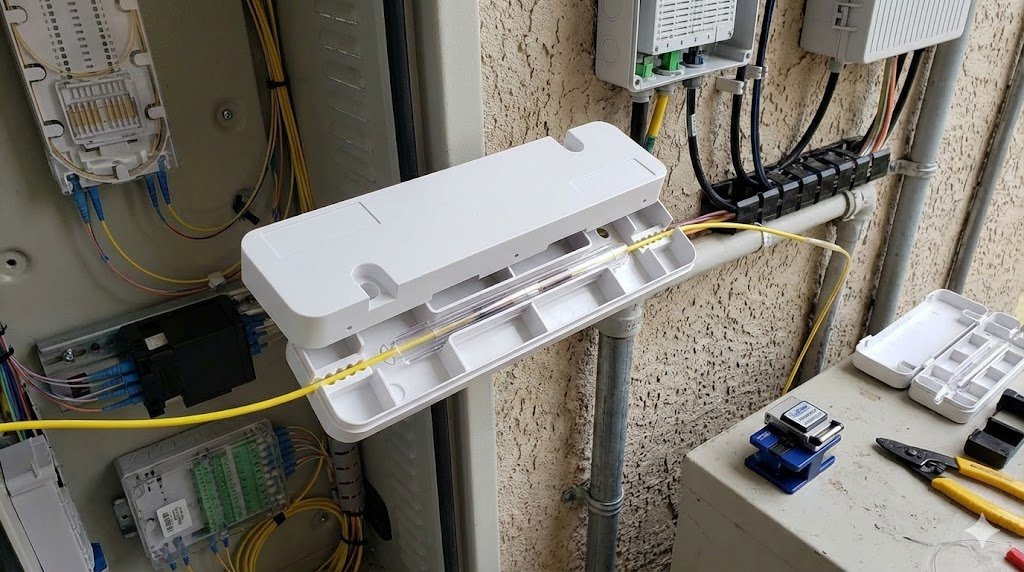
1×1 Splice Box units serve as the fundamental shield for delicate optical connections in modern fiber-to-the-home (FTTH) networks. In the rapidly expanding world of telecommunications, ensuring the longevity and signal integrity of the “last mile” is paramount. A 1×1 Splice Box is not merely a plastic enclosure; it is a critical component designed to protect the fragile fusion splice point between the drop cable and the pigtail. Without this robust protection, environmental factors such as dust, moisture, and physical impact can degrade the signal, leading to costly service interruptions and repairs. As internet service providers race to deploy gigabit speeds to residential areas, the humble yet effective 1×1 Splice Box has become a staple in ensuring that high-speed data reaches the end-user without attenuation or loss. This article delves deep into the mechanics, benefits, and installation procedures of these essential units, demonstrating why they are indispensable for a reliable network infrastructure.
The evolution of fiber optics has moved from massive backbone cables to delicate indoor installations. Consequently, the demand for compact, aesthetically pleasing, and durable protection has skyrocketed. The 1×1 Splice Box answers this call by offering a sleek form factor that blends seamlessly into residential environments while providing industrial-grade protection. Whether you are a seasoned network engineer or a procurement specialist, understanding the nuances of this device is essential for maintaining a high-quality optical network.
Understanding the Engineering Behind the 1×1 Splice Box
At its core, the 1×1 Splice Box is engineered to manage a single fiber connection. However, the simplicity of its name belies the complexity of its design requirements. These boxes must house the splice sleeve—a small tube that reinforces the fused fiber—and provide strain relief for the incoming and outgoing cables. The internal layout is meticulously designed to maintain the minimum bend radius of the optical fiber. Violating this bend radius can cause micro-bends, which result in significant signal loss. Therefore, a high-quality 1×1 Splice Box is molded with internal guides and pillars that force the fiber to curve gently, preserving the integrity of the light signal.
Material Science: Why the 1×1 Splice Box Uses ABS
The choice of material is a defining factor in the quality of a fiber protection unit. Most premium units, including those offered by EPCOM, utilize Acrylonitrile Butadiene Styrene (ABS). The ABS 1×1 Splice Box is preferred over standard PVC or generic plastics because of its superior impact resistance and thermal stability. ABS is a thermoplastic polymer that does not degrade easily under UV exposure or temperature fluctuations. In an FTTH deployment, the box might be installed in a hot attic, a damp basement, or on a sun-drenched wall. The 1×1 Splice Box made from ABS ensures that the enclosure remains rigid and protective, preventing the splice from being crushed or exposed to the elements.
Furthermore, ABS provides excellent chemical resistance. In residential environments, cleaning agents or paints might accidentally come into contact with the cabling infrastructure. A lesser material might crack or soften, but an ABS-based 1×1 Splice Box maintains its structural integrity, ensuring the network remains operational for decades. This durability translates directly to Lower Total Cost of Ownership (TCO) for network operators, as the need for replacement due to housing failure is virtually eliminated.
The Critical Role of the 1×1 Splice Box in FTTH
Fiber to the Home (FTTH) networks rely on the seamless transmission of light from the central office to the subscriber’s optical network terminal (ONT). The most vulnerable point in this entire link is the splice. When a drop cable enters a home, it must be terminated. While connectors can be used, fusion splicing is often preferred for its lower insertion loss and higher reliability. Here, the 1×1 Splice Box acts as the guardian of this permanent connection. It isolates the splice from tensile forces. If a user accidentally tugs on the visible cable, the strain relief mechanism within the box absorbs the force, leaving the delicate glass splice unaffected.
Minimizing Signal Loss with a 1×1 Splice Box
Signal attenuation is the enemy of fiber optics. Every decibel (dB) of loss reduces the efficiency of the network. A properly installed 1×1 Splice Box contributes significantly to loss prevention. By immobilizing the splice, it prevents movement-induced attenuation. Furthermore, for scenarios requiring more complex setups, such as integrating adapters for quick disconnects, operators might consider a protection box with adaptor. However, for direct splicing, the standard 1×1 unit is unmatched in simplicity and efficiency. It ensures that the fiber alignment remains pristine, preventing “macro-bends” that leak light and degrade internet speeds.
Common Causes of FTTH Signal Failure (Without Protection)
Figure 1: Estimated distribution of failure causes in unprotected fiber splices. The 1×1 Splice Box mitigates nearly all these risks.
As illustrated above, physical impact and environmental factors account for the majority of failures in unprotected connections. Implementing a robust 1×1 Splice Box effectively eliminates these variables, ensuring a stable connection that meets Fiber Optic Association (FOA) standards for network reliability.
Installation Guide: Mastering the 1×1 Splice Box
Proper installation is as critical as the hardware itself. Even the best 1×1 Splice Box cannot compensate for poor workmanship. However, the design of the EPCOM unit simplifies this process significantly. The box typically features a snap-on or screw-down lid, dedicated slots for heat-shrink splice sleeves, and cable entry points compatible with standard 2.0mm × 3.0mm FTTH drop cables.
Preparing Cables for the 1×1 Splice Box
Before the fiber is placed into the 1×1 Splice Box, the cable must be stripped precisely. Using the wrong tools can damage the cladding of the fiber, leading to micro-cracks that propagate over time. For round cables, it is imperative to use a high-precision tool like the 4.5-29mm Round Cable Stripper. This tool ensures that the outer jacket is removed without nicking the inner buffer or the glass itself.
Similarly, for the flat drop cables commonly used in FTTH deployments, utilizing a specialized Flat Drop Wire Stripper is non-negotiable. This tool separates the strength members (usually steel or FRP) from the fiber core efficiently. Once stripped, the fiber is cleaved and spliced. The splice sleeve is heated and shrunk over the joint. This assembly is then carefully pressed into the splice holder within the 1×1 Splice Box. The technician must ensure that the excess fiber is coiled gently within the box, adhering to the guides to maintain the bend radius.
Step-by-Step Assembly Protocol
- Site Survey: Determine the optimal location for the box. It should be accessible for future maintenance but out of the way of daily foot traffic.
- Cable Preparation: Strip the drop cable and the pigtail to the required lengths (typically 30mm to 50mm of bare fiber, depending on the cleaver).
- Splicing: Perform the fusion splice. Ensure the estimated loss is below 0.05dB.
- Protection: Slide the heat shrink sleeve over the splice and heat it.
- Placement: Insert the protected splice into the central groove of the 1×1 Splice Box.
- Routing: Route the fiber slack around the internal radius guides.
- Closure: Snap the lid shut or secure the screws. Verify that no fiber is pinched by the lid mechanism.
Comparative Analysis: 1×1 Splice Box vs. Alternatives
In the market, there are various types of closures, ranging from large dome closures to simple mechanical splice holders. The 1×1 Splice Box occupies a unique niche. Unlike large dome closures used on utility poles which hold hundreds of fibers, the 1×1 unit is hyper-focused on the single subscriber.
| Feature | EPCOM 1×1 Splice Box (ABS) | Generic Plastic Box | Metal Junction Box |
|---|---|---|---|
| Material Durability | High (Impact & UV Resistant) | Low (Brittle over time) | Very High (Prone to corrosion) |
| Signal Protection | Excellent (Radius Control) | Variable (Often lacks guides) | Poor (Risk of pinching) |
| Installation Speed | Fast (Snap-fit design) | Medium | Slow (Requires grounding) |
| Aesthetics | Sleek, White/Compact | Bulky | Industrial/Obtrusive |
| Cost Efficiency | High | Medium | Low |
Cost-Benefit Analysis of the 1×1 Splice Box
While metal boxes offer immense physical strength, they are overkill for indoor FTTH drop cables and can actually be detrimental if they lack internal radius management. Furthermore, metal boxes can block Wi-Fi signals if the router is placed nearby, whereas the ABS material of the 1×1 Splice Box is radio-translucent. Generic plastic boxes often lack UV stabilizers, meaning they turn yellow and brittle within a few years. The EPCOM 1×1 Splice Box strikes the perfect balance: it is affordable enough for mass deployment yet durable enough to withstand the lifespan of the network installation (typically 20+ years).
Why EPCOM Solutions Lead the Industry
EPCOM has established itself as a leader in fiber optic solutions by focusing on the details that matter to installers and network operators. The EPCOM 1×1 Splice Box is the result of rigorous testing and feedback from the field. Unlike off-the-shelf components that may suffer from loose tolerances, EPCOM units are manufactured with precision molding. This ensures that the splice sleeve is held firmly—not too tight to crush it, but not too loose to allow rattling.
Moreover, EPCOM understands that the splice box is part of a larger ecosystem. That is why the design is compatible with a wide range of standard drop cables and pigtails. The integration of high-quality stripping tools, such as the round cable and flat drop wire strippers mentioned earlier, creates a holistic workflow that minimizes errors. When technicians have the right box and the right tools, installation times drop, and first-time success rates rise.
Maintenance and Troubleshooting
Once installed, the 1×1 Splice Box requires very little maintenance, which is one of its primary advantages. However, external factors can sometimes necessitate a check-up. If a user reports signal degradation, the technician can easily open the splice box to inspect the fiber.
Inspect the 1×1 Splice Box for Damage
The first step in troubleshooting is a visual inspection. Check if the box has been physically impacted or if the cable entry points have been compromised. If the fiber inside has “popped” out of the radius guides, it indicates that the cable was pulled forcefully from the outside. The 1×1 Splice Box is designed to grip the cable jacket to prevent this, but extreme force can overcome the retention mechanism. Simply re-seating the fiber and tightening the strain relief often solves the issue.
Additionally, it is crucial to ensure that no insects or moisture have entered the enclosure. While IP-rated for indoor and semi-protected outdoor use, proper sealing is vital. If the box is deployed in a harsh outdoor environment, additional waterproofing tape or a dedicated outdoor enclosure might be required, though the standard ABS box offers significant resistance to humidity. For more on environmental standards, referencing the International Electrotechnical Commission (IEC) guidelines on enclosure ratings is recommended.
The Future of FTTH and the 1×1 Splice Box
As we move towards 10G PON (Passive Optical Network) and beyond, the tolerance for signal loss will become even lower. Higher bandwidths require cleaner signals. The role of the 1×1 Splice Box will evolve from a passive protector to an active element of network assurance. Future iterations may include tamper-evident seals or even clearer transparent covers for quick visual inspection without opening the unit. However, the fundamental physics of light transmission remains unchanged: the splice point must be immobile and protected. Therefore, the classic 1×1 Splice Box design will remain a cornerstone of optical networking for the foreseeable future.
Operators investing in high-quality passive infrastructure today are future-proofing their networks. Using a sub-standard splice protector is a false economy. Saving pennies on a box can cost hundreds of dollars in truck rolls and technician time later. EPCOM’s commitment to quality ensures that your passive infrastructure is ready for the next generation of digital services.
Frequently Asked Questions
1. Can the 1×1 Splice Box be used outdoors?
While the ABS material is UV resistant and durable, the standard 1×1 Splice Box is primarily designed for indoor or sheltered outdoor use (like inside a wall box). For direct exposure to rain, ensure the unit has an appropriate IP rating or is placed inside a larger weather-proof cabinet.
2. Does the box come with splice sleeves?
Typically, splice sleeves are sold separately or as part of a kit. The EPCOM 1×1 Splice Box is designed to accommodate standard 40mm or 60mm fusion splice protection sleeves.
3. How does the 1×1 Splice Box compare to a mechanical connector?
A mechanical connector is faster to install but has higher signal loss (0.3dB to 0.5dB). A fusion splice protected by a 1×1 Splice Box has negligible loss (<0.05dB) and is much more reliable long-term. The box provides the necessary physical protection that a bare splice lacks.
4. Is it difficult to reopen the box after installation?
No, the design usually features a snap-lock mechanism or screws that allow for re-entry. This is useful if the splice needs to be redone or verified during troubleshooting.
Conclusion
The 1×1 Splice Box is a small component with a massive impact. It stands as the silent sentinel at the edge of the optical network, ensuring that the high-speed potential of fiber optics is fully realized inside the subscriber’s home. By choosing high-quality ABS units from EPCOM, utilizing the correct stripping tools, and adhering to proper installation protocols, network operators can guarantee a robust, efficient, and long-lasting FTTH deployment. In a world where connectivity is as essential as electricity, the reliability provided by a superior 1×1 Splice Box is invaluable. Invest in quality protection today to ensure the seamless connectivity of tomorrow.