GJDFJV Fiber Optic Cable: Reliable Data Solution
GJDFJV Fiber Optic Cable is rapidly becoming the gold standard for indoor network distribution due to its unique balance of flexibility, high density, and safety features. In the modern era of telecommunications, where bandwidth demands are skyrocketing, selecting the right cabling infrastructure is not just a technical detail; it is a critical business decision. Network engineers and facility managers are constantly seeking solutions that offer ease of installation without compromising on signal integrity. This is where this specific cable type excels, providing a robust solution for data centers, office buildings, and residential complexes.
The architecture of a reliable network begins at the physical layer. While much attention is paid to active equipment like switches and routers, the passive cabling determines the longevity and reliability of the system. EPCOM understands this necessity. We have observed a significant shift towards non-metallic, tight-buffered, or ribbon cables for indoor applications. The GJDFJV Fiber Optic Cable specifically addresses the challenges of indoor routing, including tight bends, vertical rises, and the need for flame-retardant materials. By eliminating metallic strength members, it ensures safety in high-voltage environments while maintaining superior tensile strength through advanced aramid yarn reinforcement.
Throughout this comprehensive guide, we will explore every facet of this technology. From its internal construction and material composition to practical installation techniques and performance metrics, we aim to provide you with authoritative knowledge. Whether you are upgrading an existing local area network (LAN) or designing a new Fiber-to-the-Home (FTTH) deployment, understanding the capabilities of GJDFJV Fiber Optic Cable will empower you to build a future-proof network that stands the test of time.
Understanding the Construction of GJDFJV Fiber Optic Cable
To truly appreciate the value of GJDFJV Fiber Optic Cable, one must first dissect its name and construction. In the fiber optic industry, naming conventions are not random; they tell a story about the cable’s intended use and durability. The acronym typically breaks down as follows: “GJ” signifies an indoor optical cable, “D” often refers to the optical fiber ribbon or a specific non-metallic structure depending on the regional standard (often YD/T 1258 in manufacturing contexts), “F” stands for non-metallic strength members, “J” indicates tight-buffered fiber or fiber coating, and “V” represents a PVC outer sheath (though LSZH variants are common).
The core advantage of this design lies in its “All-Dielectric” nature. Unlike outdoor cables that may use steel tape for armoring, GJDFJV Fiber Optic Cable relies on high-modulus aramid yarns (Kevlar) for tensile strength. This makes the cable immune to electromagnetic interference (EMI) and lightning strikes, a crucial feature for indoor cables that run parallel to electrical power lines. Furthermore, the tight-buffered or ribbon design allows for a smaller diameter compared to loose-tube cables. This reduction in size is critical when retrofitting older buildings with limited conduit space.
Material selection plays a pivotal role. The outer jacket is typically made of Polyvinyl Chloride (PVC) or Low Smoke Zero Halogen (LSZH) material. In the event of a fire, LSZH jackets do not emit toxic halogen gases, which is a mandatory requirement for many public buildings and data centers. The fibers inside—whether Single Mode (G.652, G.657) or Multimode (OM3, OM4)—are color-coded for easy identification. This meticulous construction ensures that the GJDFJV Fiber Optic Cable is not only a conduit for light but a highly engineered component designed for safety and efficiency.
The Role of Aramid Yarn in GJDFJV Fiber Optic Cable
One cannot discuss the strength of GJDFJV Fiber Optic Cable without highlighting the role of aramid yarn. This synthetic fiber is heat-resistant and strong, offering a high strength-to-weight ratio. In the context of fiber optics, it serves as the primary tension-bearing element. During installation, cables are often pulled through long ducts, subjecting them to significant tensile stress. If this stress were transferred directly to the glass fibers, it would cause micro-cracks or immediate breakage.
The aramid yarn surrounds the fiber core, absorbing the pulling force. For indoor distribution cables like the GJDFJV Fiber Optic Cable, this allows for a surprisingly high tensile load despite the cable’s flexibility. It also provides a degree of cut resistance. When technicians strip the cable, the aramid yarn serves an additional purpose: it can be used as a rip cord to safely slice through the outer jacket without damaging the delicate optical fibers inside. This dual functionality of protection and installation aid is a hallmark of high-quality indoor distribution cables.
Why Data Centers Prefer GJDFJV Fiber Optic Cable
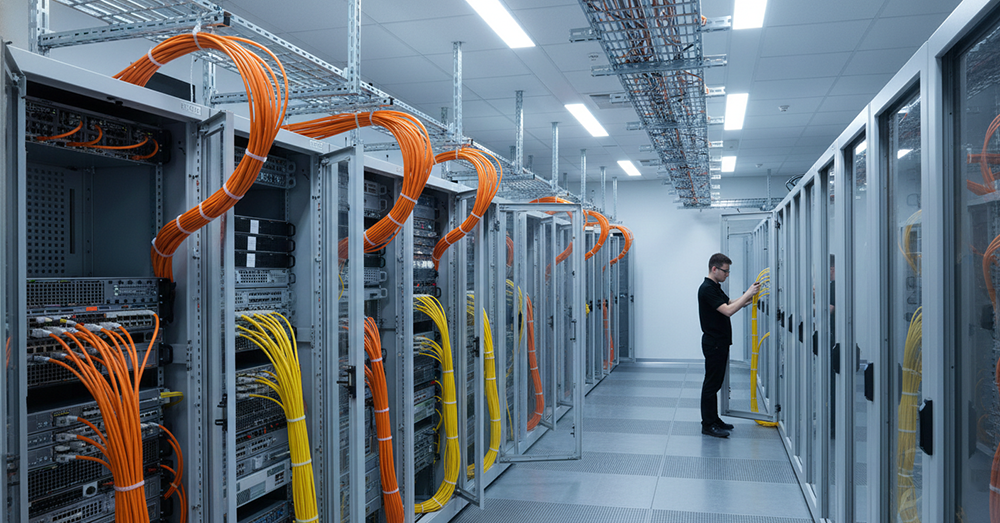
Data centers are the beating heart of the digital economy, and they require cabling that maximizes density and minimizes airflow obstruction. The GJDFJV Fiber Optic Cable is uniquely suited for this environment. Its compact footprint allows for higher fiber counts in smaller pathways. In high-density patching areas, every millimeter of space saved in a cable tray improves cooling efficiency by allowing better air circulation. This thermal management is critical in server rooms running 24/7.
Moreover, the multi-core nature of these cables facilitates rapid deployment. Instead of pulling twelve individual simplex cables, a single 12-core or 24-core GJDFJV Fiber Optic Cable can be installed. This significantly reduces installation time and labor costs. Once routed to the equipment rack, these cables are often terminated into high-density cassettes. For instance, utilizing an MPO/MTP Module Cassette allows for the seamless transition from the multi-fiber trunk cable to individual patch cords. This modular approach, supported by the right cable choice, ensures that the data center can scale up bandwidth easily without a complete overhaul of the cabling infrastructure.
Another factor is the ease of termination. The tight-buffered design of standard GJDFJV Fiber Optic Cable means the fibers are easier to handle than gel-filled loose tubes found in outdoor cables. Technicians do not need to spend time cleaning messy gel, which speeds up the splicing or connectorization process. In a mission-critical environment where downtime is costly, the speed of maintenance and upgrades provided by this cable type is invaluable.
Installation Scenarios for GJDFJV Fiber Optic Cable
Beyond the data center, the GJDFJV Fiber Optic Cable is the workhorse of Fiber-to-the-Desk (FTTD) and vertical riser applications in office buildings. Its flexibility allows it to be routed around tight corners and through modular furniture partitions without exceeding the macro-bend radius limits. This bend insensitivity is vital because real-world office installations are rarely straight lines; they involve twists, turns, and loops.
In a typical office setup, the cable might run from a floor distributor to a wall outlet or a consolidation point. Here, the cable is terminated to provide connectivity to end-user devices. A common termination point is the 4 Cores Fibre Optic Faceplate, which provides a neat, protective interface for the fiber connection. The compatibility of GJDFJV cables with these standard faceplates ensures a professional finish that protects the fiber ends from dust and physical damage.
Furthermore, in residential FTTH (Fiber to the Home) scenarios, this cable often bridges the gap between the building’s entry facility and the user’s living space. The non-metallic nature ensures no grounding is required, simplifying the installation. When connecting the distribution cable to the optical network unit (ONU), technicians might need to splice pigtails. In such cases, a Protection Box with Adaptor is essential. This small enclosure protects the fusion splice point and secures the fragile fiber transition, ensuring that the robust GJDFJV Fiber Optic Cable connection remains stable for years.
Technical Specifications and Performance
When selecting a GJDFJV Fiber Optic Cable, engineers must look closely at the technical specifications. These metrics define the cable’s operational limits and transmission quality. Key parameters include attenuation (signal loss), chromatic dispersion, and mechanical properties like crush resistance and tensile strength. EPCOM ensures that our cables meet or exceed international standards such as IEC 60794 and ITU-T recommendations.
The table below outlines standard technical specifications for a typical high-quality indoor distribution cable. Note the differences in attenuation between wavelengths, which dictates the suitable transmission distance.
| Parameter | Specification | Unit / Note |
|---|---|---|
| Fiber Type | G.652D / G.657A1 / OM3 / OM4 | Single Mode or Multimode |
| Attenuation @ 1310nm | ≤ 0.36 | dB/km |
| Attenuation @ 1550nm | ≤ 0.22 | dB/km |
| Short Term Tensile Strength | 600 (typical for 12-core) | Newton (N) |
| Long Term Tensile Strength | 200 (typical for 12-core) | Newton (N) |
| Crush Resistance (Short Term) | 1000 | N/100mm |
| Crush Resistance (Long Term) | 300 | N/100mm |
| Min. Bending Radius (Dynamic) | 20 x Cable Diameter | During Installation |
| Min. Bending Radius (Static) | 10 x Cable Diameter | After Installation |
| Operating Temperature | -20 to +60 | Degrees Celsius |
It is important to note that the attenuation values are critical for calculating the optical power budget. For GJDFJV Fiber Optic Cable, the low attenuation ensures that signals can travel significant distances within a campus or building without the need for repeaters. Additionally, the crush resistance values indicate how well the cable can withstand pressure, such as being stepped on or compressed by other cables in a tray.
Comparing GJDFJV Fiber Optic Cable with Loose Tube Cables
A common question arises: why choose GJDFJV Fiber Optic Cable over traditional outdoor loose tube cables? The answer lies in the application environment. Loose tube cables are designed to isolate the fiber from external stresses like thermal expansion and moisture, making them ideal for outdoor environments. However, they are filled with gel (thixotropic jelly) which is messy to clean and requires a breakout kit to terminate indoors. This adds time and cost to the project.
In contrast, GJDFJV Fiber Optic Cable uses a tight-buffered design (or semi-tight ribbon). The buffer coating is applied directly to the fiber, providing physical protection that allows for direct termination with connectors. This eliminates the need for splice trays in many applications and significantly reduces termination time. While loose tube cables are superior for moisture resistance outdoors, they lack the flexibility and fire safety ratings (like LSZH) required for indoor risers and plenums.
Installation Efficiency Comparison
The chart below illustrates the relative efficiency and characteristics of GJDFJV cables compared to standard Loose Tube cables in an indoor setting.
As depicted in the chart, the installation advantages are clear. For indoor projects where labor costs are a significant portion of the budget, choosing GJDFJV Fiber Optic Cable can lead to substantial savings. The “Dry” nature of the cable means no cleaning solvents are needed, improving the health and safety of the installation environment.
Handling and Storage of GJDFJV Fiber Optic Cable
Proper handling is essential to maintain the performance of any optical fiber product. Although GJDFJV Fiber Optic Cable is robust, it is not indestructible. During storage, cable drums should always be kept upright on their flanges, never lying flat. This prevents the cable layers from crushing each other. The storage environment should be dry and protected from direct sunlight and extreme temperature fluctuations, which could accelerate the aging of the PVC or LSZH jacket.
During deployment, installers must strictly adhere to the minimum bending radius. Exceeding this limit can cause macro-bending losses, where light escapes the fiber core, leading to high attenuation. For GJDFJV Fiber Optic Cable, the dynamic bending radius (during pulling) is larger than the static radius (once installed). Using proper swivels during the pulling process prevents the cable from twisting, which can damage the internal aramid yarns and the fibers themselves.
Testing and Troubleshooting
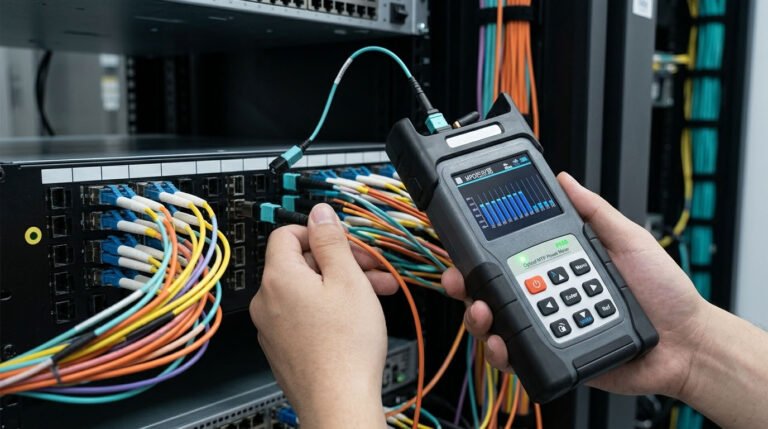
Once the GJDFJV Fiber Optic Cable is installed and terminated, rigorous testing is required to certify the link. An Optical Time Domain Reflectometer (OTDR) is commonly used to measure the length of the fiber and identify any events such as splices, connectors, or potential breaks. An Optical Loss Test Set (OLTS) provides the total insertion loss of the link.
If high loss is detected, technicians should first inspect the connector end-faces. Dirt and oil are the enemies of fiber optics. Using a specialized fiber microscope and cleaner is mandatory. If the issue persists, the fault might be a tight bend or a pinch point along the cable run. The GJDFJV Fiber Optic Cable is designed to be resilient, but sharp edges in trays or over-tightened zip ties can still cause issues. Ensuring “loose” management of the cable ensures long-term reliability.
Future-Proofing Your Network with GJDFJV Fiber Optic Cable
The telecommunications landscape is constantly evolving. With the advent of 5G, IoT (Internet of Things), and Wi-Fi 6/7, the backbone infrastructure must be capable of supporting higher speeds. Today’s 10Gbps links will soon be upgraded to 40Gbps, 100Gbps, or even 400Gbps. Installing high-quality GJDFJV Fiber Optic Cable today is an investment in that future.
Multimode versions of this cable (OM4, OM5) are optimized for VCSEL lasers used in high-speed short-reach transceivers. Single-mode versions (OS2) offer virtually unlimited bandwidth for building backbones. By deploying a high-count GJDFJV Fiber Optic Cable now, facility managers ensure they have “dark fiber” (unused strands) available for future expansion. This eliminates the need for costly and disruptive re-cabling works down the line. It supports the convergence of various building systems—security, HVAC control, and data—onto a single, unified fiber IP network.
Why Choose EPCOM for Your Cabling Needs
At EPCOM, we are committed to providing superior connectivity solutions. Our GJDFJV Fiber Optic Cable is manufactured under strict quality control processes to ensure consistency and performance. We understand that a cable is not just a product; it is the lifeline of your business’s communication.
We offer a complete ecosystem of products to support your installation. From the high-capacity cables themselves to the necessary accessories like the MPO/MTP Module Cassette for high-density interconnects, the convenient 4 Cores Fibre Optic Faceplate for end-user termination, and the essential Protection Box with Adaptor for secure splicing. When you choose EPCOM, you are choosing a partner dedicated to technical excellence and customer success.
Conclusion
In conclusion, the GJDFJV Fiber Optic Cable represents the ideal synthesis of mechanical strength, ease of use, and optical performance for indoor environments. Its non-metallic, tight-buffered construction solves the specific challenges of indoor routing, making it the preferred choice for data centers, office networks, and FTTH deployments. By understanding its construction, benefits, and proper installation techniques, network professionals can deploy infrastructure that is safe, reliable, and ready for the bandwidth demands of tomorrow.
Don’t compromise on your network’s foundation. Invest in quality cabling that delivers results. Explore the full range of EPCOM solutions and ensure your data travels on the best path possible. Whether you are connecting a server farm or a smart home, the GJDFJV Fiber Optic Cable is the reliable link you can trust.