

MPO/MTP Optical Power Meter: Precision Fiber Testing
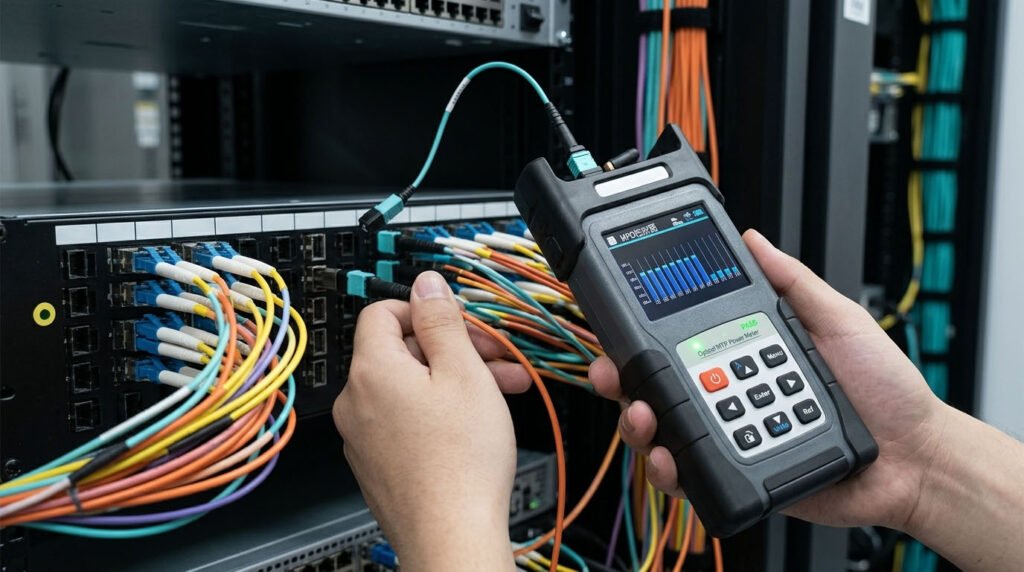
MPO/MTP Optical Power Meter devices represent the pinnacle of modern telecommunications testing infrastructure. In the rapidly evolving landscape of high-density data centers, the necessity for precise measurement has never been greater. Consequently, network engineers rely on these specialized tools to ensure every fiber link meets stringent performance criteria. By utilizing an MPO/MTP Optical Power Meter from EPCOM, technicians can verify multi-fiber connectors in a single scan, significantly reducing the time required for site certification. Furthermore, the integration of such advanced testing equipment guarantees that high-speed protocols like 400G and 800G operate without signal degradation.
Transitioning from legacy single-fiber systems to parallel optics requires a fundamental shift in diagnostic strategy. Because MPO/MTP connectors house multiple fibers in a single ferrule, traditional power meters often fail to provide individual lane visibility. This is where the MPO/MTP Optical Power Meter excels. It provides a comprehensive analysis of power levels across all 8, 12, or 24 fibers simultaneously. Therefore, EPCOM focuses on delivering high-accuracy instrumentation that simplifies complex network validation tasks.
The Role of MPO/MTP Optical Power Meter in Modern 400G Networks
As data demand surges, the adoption of parallel optics has become the industry standard. However, maintaining these links involves more than just physical installation. An MPO/MTP Optical Power Meter serves as the primary defense against excessive insertion loss. In fact, even a microscopic speck of dust can compromise a high-density connection. Thus, regular testing is paramount. EPCOM provides the necessary tools to monitor these critical interfaces, ensuring that data packets flow uninterrupted across global networks.
Moreover, the versatility of an MPO/MTP Optical Power Meter allows it to handle various polarity types. Whether your network uses Method A, B, or C, the device identifies misconfigurations instantly. This capability is essential because incorrect polarity is a leading cause of link failure during initial deployment. By choosing EPCOM, operators gain access to intuitive interfaces that translate complex optical data into actionable insights.
Why Your Infrastructure Needs an MPO/MTP Optical Power Meter
Efficiency remains a top priority for data center managers. Specifically, the ability to test multiple fibers at once translates to lower labor costs. An MPO/MTP Optical Power Meter eliminates the need for cumbersome breakout cables during basic power verification. Nevertheless, for comprehensive troubleshooting, using a high-quality MPO-MTP Patch Cord ensures that the reference signal remains stable throughout the testing cycle.
Additionally, consistency in measurement is achieved through superior sensor technology. EPCOM engineering ensures that each MPO/MTP Optical Power Meter is calibrated to international standards. This precision allows for a narrower margin of error, which is critical when working within tight optical loss budgets. Because of this, leading telecommunications providers consistently choose EPCOM for their backbone infrastructure audits.
Figure 1: Performance stability analysis using EPCOM measurement solutions.
Technical Specifications of the MPO/MTP Optical Power Meter
Understanding the internal mechanics of these devices is vital for professional technicians. Usually, an MPO/MTP Optical Power Meter utilizes an InGaAs detector array. This array allows the device to capture light from multiple sources simultaneously without cross-talk. EPCOM integrates advanced filtering algorithms to ensure that the readings are not affected by ambient light or connector reflections. Consequently, the resulting data is both reliable and repeatable.
Furthermore, connectivity options have evolved. Modern versions of the MPO/MTP Optical Power Meter now feature USB and Bluetooth interfaces for real-time data logging. This digital integration allows for the immediate generation of PDF reports, which can be shared with project stakeholders. In summary, EPCOM provides a bridge between physical layer testing and digital asset management.
| Feature | EPCOM Standard | Industry Average |
|---|---|---|
| Wavelength Range | 850nm – 1625nm | 850nm – 1550nm |
| Measurement Speed | < 0.5 Seconds | ~ 2.0 Seconds |
| Interface Support | MPO-12, MPO-24, MTP | MPO-12 Only |
Optimizing Data Center Links with EPCOM Solutions
The layout of a modern server room requires structured cabling components that are both robust and easy to test. For example, the 3U MPO-MTP Patch Panel serves as the nerve center for high-density fiber management. When combined with an MPO/MTP Optical Power Meter, technicians can perform routine audits of the entire panel in record time. Because the 3U design supports thousands of connections, having a fast testing tool is not just an advantage; it is a necessity.
Meanwhile, the complexity of “Top of Rack” (ToR) architectures demands high-performance breakout solutions. Using MPO-MTP Breakout Cables allows for the conversion of high-speed trunks into manageable individual links. During this transition, an MPO/MTP Optical Power Meter ensures that the breakout transition does not introduce unexpected decibel losses. EPCOM designs these products to work in harmony, creating a seamless ecosystem for fiber optic professionals.
Maintenance and Calibration of EPCOM Testing Tools
To maintain peak performance, every piece of optical equipment requires regular maintenance. For an MPO/MTP Optical Power Meter, cleaning the input port is the most critical task. Dust accumulation can lead to inaccurate readings and potential damage to the internal sensors. Therefore, EPCOM recommends using specialized cleaning kits after every ten measurements. This proactive approach extends the lifespan of the MPO/MTP Optical Power Meter and maintains the integrity of your network documentation.
Calibration cycles are equally important. Typically, an MPO/MTP Optical Power Meter should be sent to an authorized laboratory once per year. This process involves comparing the device’s readings against a NIST-traceable standard. By adhering to these guidelines, EPCOM users can be confident that their test results will withstand any rigorous third-party audit. Ultimately, the accuracy of your MPO/MTP Optical Power Meter reflects the reliability of your entire communication system.
Future Trends in MPO/MTP Optical Power Meter Technology
The industry is currently moving toward even higher fiber counts, such as 32-fiber and 48-fiber MPO connectors. Consequently, the next generation of the MPO/MTP Optical Power Meter will need to adapt. EPCOM is already researching automated switching matrices that can handle these increased densities without increasing the physical footprint of the tool. Furthermore, the integration of Artificial Intelligence (AI) for predictive fault analysis is on the horizon. This means a future MPO/MTP Optical Power Meter might not only tell you the current power level but also predict when a link is likely to fail due to environmental stress.
In addition to hardware improvements, software ecosystems are becoming more open. Cloud-based storage for test results allows global teams to collaborate on a single project in real-time. Therefore, when a technician uses an MPO/MTP Optical Power Meter in a Singapore data center, an engineer in New York can instantly verify the results. EPCOM remains committed to these advancements, ensuring our customers are always at the forefront of the fiber optic revolution.
Finally, we must consider the environmental impact of manufacturing. EPCOM is striving to use recyclable materials in the construction of every new MPO/MTP Optical Power Meter. By reducing our carbon footprint, we provide solutions that are not only technically superior but also ethically responsible. In conclusion, the MPO/MTP Optical Power Meter is more than just a tool; it is a fundamental component of the world’s digital future.