Secure Telecom with the Drop Mandrel Clamp
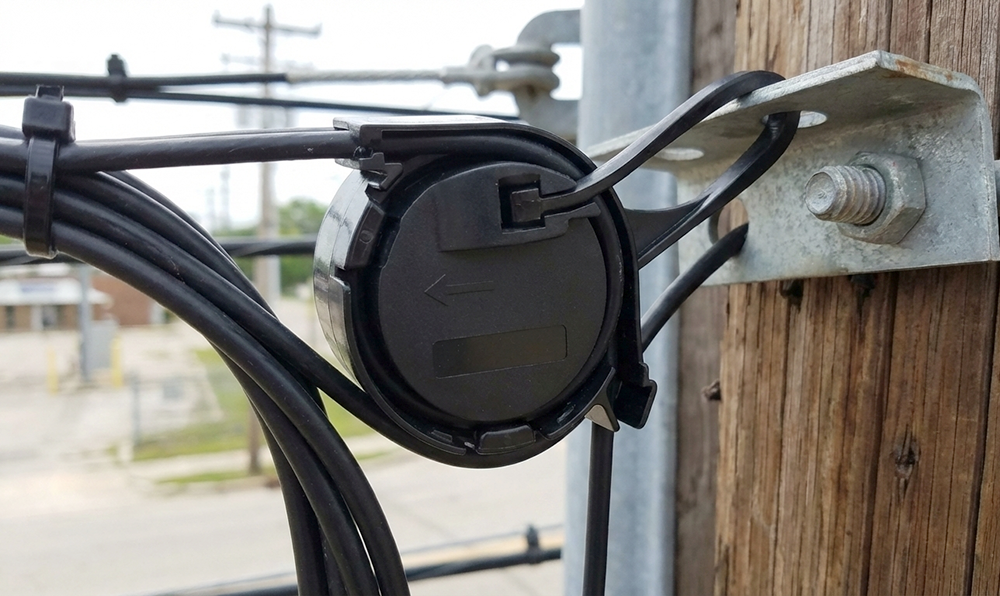
Drop Mandrel Clamp technology stands as a fundamental component in the reliable deployment of aerial drop cables. This simple yet critical piece of hardware is the key to maintaining signal integrity and cable longevity in last-mile connectivity. It ensures that the final link from a distribution point to a customer premise remains securely tensioned and anchored. Consequently, the performance of fiber-to-the-home (FTTH) and traditional copper drops relies heavily on the quality and correct installation of these clamps. Moreover, these clamps must withstand harsh environmental conditions, including wind loading, temperature fluctuations, and UV exposure, for decades.
Furthermore, selecting the appropriate drop wire clamp directly impacts the service lifespan and reduces maintenance costs. A poorly secured cable can lead to unacceptable levels of attenuation or even mechanical failure. Therefore, system engineers prioritize clamps that offer both high mechanical strength and exceptional durability. This selection process often involves reviewing specifications like load retention capability and material composition. High-grade polymer or galvanized steel components are typically chosen for maximum resilience. The primary function of this clamp is to serve as a dead-end anchor. This means it terminates the cable at the pole or building, absorbing the tension exerted across the aerial span.
The Technical Mechanism of the Drop Mandrel Clamp
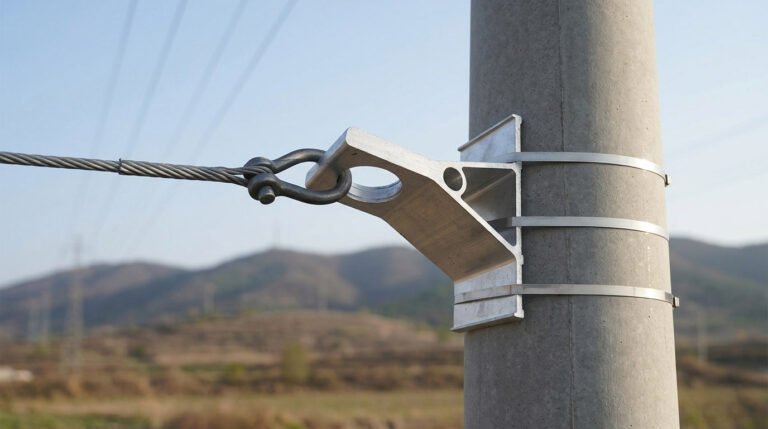
Understanding the mechanics of the aerial Drop Mandrel Clamp is crucial for proper deployment. It is not simply a grip; it is an engineered solution for strain relief. The most common designs feature a mandrel-shaped body and a wedge or bail wire mechanism. The cable is typically looped or wrapped around the mandrel several times. This action utilizes friction and the cable’s own bending stiffness to create a self-tightening grip. Subsequently, as tension is applied to the span, the cable tightens further around the mandrel, securing the hold without exerting damaging radial pressure on the fiber core or conductor.
This non-compressive grip is a significant advantage over older, crushing-style clamps. Older models risked micro-bending loss in fiber optic cables, leading to signal degradation. However, the mandrel design minimizes stress on the delicate inner components of the cable. The mechanism often includes an opening bail or hook. This feature allows for direct attachment to various pole fittings, such as brackets, drive hooks, or J-hooks. Installation is designed to be fast, simple, and often tool-free. This dramatically cuts down on installation time and labor costs in large-scale rollout projects.
The Drop Mandrel Clamp is commonly categorized by the cable profile it accommodates: flat or round. Flat drop cables, often used in older copper networks or specific FTTH applications, require clamps tailored to their rectangular cross-section. Conversely, round drop cables, prevalent in modern fiber installations, use clamps designed for circular geometry, often ensuring three to four full turns around the internal mandrel for optimal grip. Both types share the core principle of controlled strain relief. Furthermore, the clamp components are typically made from UV-stabilized thermoplastics, such as Nylon 6. This material choice is essential for long-term outdoor use, guaranteeing a minimum lifespan and resistance against environmental degradation. The thermoplastic housing often incorporates a robust metal hook—frequently galvanized steel or stainless steel—for secure attachment to the anchor point.
Consequently, these clamps must meet rigorous tensile strength and environmental testing standards. They are engineered to sustain continuous tension loads, often specified in Newtons or kilograms, without slippage. The mechanical strength ensures that severe weather events, such as high winds or ice loading, do not compromise the cable attachment. Moreover, the clamp design frequently includes features for cable slack adjustment. This ability to fine-tune tension in the field is vital for achieving the perfect sag profile in the aerial span, which prevents unnecessary strain on the equipment at either end.
The rise of fiber optics has particularly emphasized the need for specialized Drop Mandrel Clamp hardware. Fiber optic drops are inherently more sensitive to bending and pressure than traditional copper wires. Therefore, the clamp must provide a gentle, yet firm, dead-end solution. This technology allows technicians to rapidly secure high-value fiber infrastructure with minimal risk of optical performance loss. In essence, the clamp acts as a reliable intermediary, bridging the gap between the aerial distribution network and the customer’s property. It is the silent protector of high-speed data transmission. This widespread adoption across global telecommunications signifies the clamp’s undeniable value. Therefore, it remains an indispensable item in every technician’s toolkit. The evolution of clamp design continues, driven by the ever-decreasing size and increasing sensitivity of modern fiber cables. Hence, manufacturers are constantly refining their designs to improve performance and installation speed. This commitment to improvement ensures long-term network stability.
The Role of Precision in Hardware Manufacturing
The foundational success of any aerial network hinges on the reliability of its components. Consequently, manufacturers must adhere to the highest standards of quality control and material science. This is where industry leaders like EPCOM distinguish themselves. EPCOM focuses intensely on providing robust, performance-engineered solutions designed to exceed the operational lifespan of the cable itself. The careful selection of components, from the UV-resistant polymers to the corrosion-proof metals, ensures long-term stability and minimal total cost of ownership.
Moreover, the versatility of the Drop Mandrel Clamp is often enhanced by its complementary hardware. For instance, the clamp is rarely installed in isolation. It requires accompanying wire anchors and pole line fittings to complete the drop installation loop. Understanding this comprehensive requirement allows EPCOM to offer full-spectrum solutions for both telecommunications and electric power applications. Furthermore, the clamps must seamlessly integrate with various mounting surfaces, whether wood, steel, or concrete poles, or building façades. This versatility makes the Drop Mandrel Clamp an adaptable solution for diverse infrastructural needs worldwide.
EPCOM’s Drop Mandrel Clamp and Network Solutions
EPCOM recognizes that securing the last mile demands more than just a single clamp; it requires a coordinated system of pole line hardware. This systematic approach ensures that every component works in harmony to prevent cable damage and signal disruption. When considering accessories for drop cable management, technicians often turn to high-quality components designed for maximum installation efficiency. A perfect example of this synergy is the specialized Plastic Wire Anchor with Steel Hook. This product provides a robust, non-conductive anchoring point, specifically engineered to secure service drops efficiently. Such specialized anchors are essential for reducing strain and ensuring a neat, professional installation finish.
Critical Telecom Hardware for Last-Mile Connectivity
The entire ecosystem of last-mile fiber and copper deployment relies on specialized Critical Telecom Hardware for Last-Mile Connectivity. This category extends far beyond the Drop Mandrel Clamp, encompassing termination boxes, splicing enclosures, and distribution closures. EPCOM supplies these items with the same commitment to environmental resilience and durability. Therefore, when specifying hardware for a new network build or an existing infrastructure upgrade, system integrators seek solutions that simplify maintenance while maximizing network uptime. Conversely, using inferior hardware risks compromising the entire drop segment, leading to costly call-outs and customer dissatisfaction. The telecom environment is constantly evolving. Consequently, hardware must adapt to support increased bandwidth requirements and denser fiber counts.
Comprehensive Electric Power Pole Line Hardware Solutions
While the Drop Mandrel Clamp is primarily a telecom component, EPCOM’s expertise extends to heavier-duty applications. The need for robust aerial support is equally critical in the utility sector. This is why EPCOM offers Comprehensive Electric Power Pole Line Hardware Solutions. This includes cross-arm braces, secondary racks, insulators, and heavy-duty dead-end clamps required for medium- and low-voltage electrical distribution. Although these components handle significantly different loads than fiber drops, they share the common requirements of galvanic corrosion resistance, high mechanical strength, and adherence to utility safety standards. Furthermore, the principles of pole attachment and securing overhead lines remain analogous, whether managing a high-tension power line or a delicate fiber drop. Therefore, EPCOM applies its manufacturing rigor across both hardware categories, ensuring dependable performance in all aerial deployments.
Comparative Analysis of Drop Mandrel Clamp Performance
When making procurement decisions, engineers frequently compare different styles of Drop Mandrel Clamp hardware. Key performance indicators (KPIs) include Ultimate Tensile Strength (UTS), UV degradation resistance, and ease of installation. A structured comparison clarifies the trade-offs between different materials and designs.
| Feature | Standard Polymer Clamp | Heavy-Duty Mandrel Clamp | Flat Wire Clamp (Wedge) |
|---|---|---|---|
| Material | UV-Stabilized Nylon | Fiber-Reinforced Thermoplastic | Galvanized Steel/ABS |
| Cable Type | Round FO Drop (2-6mm) | Round FO/Figure-8 (3-7mm) | Flat Telco/Copper Drop |
| Max Span (Meters) | 70m | 100m+ | 50m |
| Tool Requirement | None (Tool-Free) | Minimal (Tension Tool Only) | None |
This table immediately illustrates the different use-cases available in the market. Consequently, the choice depends entirely on the specific application, span length, and expected load. Furthermore, visualizing the performance difference provides critical insight. The following chart conceptualizes the installation time versus the failure rate across the lifecycle of different clamps. The Drop Mandrel Clamp system is inherently designed to favor speed and long-term stability.
Installation Efficiency vs. Failure Rate by Clamp Type
Installation Best Practices for Maximum Drop Mandrel Clamp Performance
Achieving optimal performance from any Drop Mandrel Clamp starts with meticulous installation. Rushing the process can compromise the long-term integrity of the cable and the network. Technicians must first perform a thorough route survey. This survey identifies obstacles, determines appropriate sag levels, and confirms the required anchor points. The goal is to minimize stress on the cable and ensure adherence to the National Electrical Safety Code (NESC) or local utility pole attachment regulations. This is paramount for safety and regulatory compliance.
Furthermore, proper cable preparation is essential. Before securing the cable, installers must ensure they are working only with the strength member, never pulling directly on the fiber or conductor itself. This prevents internal damage. The simple, intuitive design of the Drop Mandrel Clamp facilitates this process. The cable is simply introduced at the entry point and wound around the mandrel. For a standard 4mm fiber drop, three full, neat turns are often recommended to maximize the friction grip. This coiling action is crucial. It ensures that the tension load is distributed across the coil’s surface area rather than concentrated at a single point, which would damage the cable jacket.
Essential Field Checks Before Finalizing the Dead-End
Several checks must be completed before locking the clamp’s bail wire or wedge. First, the installer must adjust the cable tension to achieve the specified sag. The sag-tension relationship is critical. Too little sag results in excessive tension, stressing the Drop Mandrel Clamp and potentially pulling down the entire span. Conversely, too much sag risks creating clearance violations and premature wear from swaying. Consequently, dynamic load factors, such as ice and wind, must be considered in the initial tensioning calculation. Secondly, installers must adhere to strict guidelines for maintaining the cable’s minimum bend radius. Fiber optic cables are particularly vulnerable to signal loss if bent too sharply. The smooth, contoured surfaces of a high-quality mandrel clamp are designed to facilitate a gentle bend, ensuring the fiber remains intact and functional.
Moreover, the attachment of the clamp to the pole or structure requires the correct supporting hardware. Using an incompatible anchor, such as an undersized drive hook, can lead to failure under peak load conditions. The clamp’s bail wire or steel hook must sit flush and securely within the chosen anchor point. The entire assembly must be capable of withstanding the minimum failing load specified by the manufacturer, typically far exceeding the operational load. Ultimately, detailed training on these best practices is what converts robust hardware into reliable, long-lasting network infrastructure. It is a detail-oriented process that demands precision. Therefore, standardization is key across all deployment teams.
Material Science and Durability: What Makes a Quality Drop Mandrel Clamp
The longevity of a Drop Mandrel Clamp is primarily determined by its material composition. Since these components live in the harsh outside plant (OSP) environment, they must offer superior resistance to corrosion, UV radiation, and temperature extremes. This is not optional; it is fundamental to performance.
Deep Dive into Polymer Selection
Most modern Drop Mandrel Clamp bodies are constructed from engineered thermoplastics, often UV-stabilized Nylon 6 or fiberglass-reinforced compounds. This material choice offers an optimal balance of strength, lightweight construction, and dielectric properties. The UV stabilization is non-negotiable. Without it, standard polymers degrade rapidly when exposed to sunlight, becoming brittle and prone to cracking within a few years. Consequently, this degradation would lead to catastrophic cable drops. EPCOM prioritizes materials that guarantee a minimum 25-year service life, often validated through accelerated climatic aging tests. The non-conductive nature of the polymer body also provides crucial electrical isolation, which is vital when the clamp is installed near electrical utility infrastructure. Furthermore, advanced additives in the polymer compound improve its resistance to chemical degradation from pollutants or acid rain, further extending the component’s lifespan in industrial environments.
The Importance of Corrosion-Resistant Hooks
While the body is typically plastic, the anchoring hook or bail is nearly always metal to handle the high tensile forces. This metal must be heavily protected against rust and galvanic corrosion. Hot-dip galvanization is the standard treatment for steel components, providing a thick, durable zinc coating. For applications demanding the utmost resilience, stainless steel may be employed. However, hot-dip galvanized steel offers excellent performance and superior cost-efficiency for most standard Drop Mandrel Clamp installations. The junction between the metal hook and the polymer body is also a critical design point. It must be molded or designed to prevent stress concentration, ensuring that the anchor point remains the strongest part of the assembly. This engineering detail is often overlooked but determines the clamp’s maximum load bearing capacity.
The synergy between the polymer body and the metal hook defines the overall integrity of the final dead-end. The clamp must distribute the load smoothly from the cable, through the mandrel, and finally to the anchor point without creating any single point of failure. Consequently, the material specifications often include details on the clamp’s resistance to pull-out forces and its ability to withstand cyclical loading due to wind vibration. High-performance clamps often boast pull-out resistance ratings far in excess of the typical cable’s minimum breaking strength. This margin of safety is what ensures network reliability during extreme weather.
Case Studies in Aerial Drop Cable Deployment
The practical application of the Drop Mandrel Clamp across different geographical terrains highlights its essential flexibility. Consider a deployment project in a coastal region. Here, salt spray and high humidity accelerate corrosion. In this scenario, clamps with stainless steel hooks or heavily galvanized coatings are mandatory. Furthermore, the cable jacketing itself must resist environmental damage. The Drop Mandrel Clamp provides a mechanical termination that complements this resilient cable jacket. The success of coastal installations, therefore, is a direct result of meticulous material specification.
Conversely, in regions experiencing heavy snow and ice loading, the mechanical strength of the clamp is tested severely. Ice accumulation dramatically increases the weight on the aerial span, translating to immense stress at the dead-end anchor points. The Drop Mandrel Clamp used here must possess a certified minimum failing load that accounts for these extreme weather scenarios. Moreover, the self-tightening characteristic of the mandrel design is a distinct advantage. As the span tension temporarily increases due to ice, the clamp’s grip tightens further, preventing dangerous slippage that could result in cable failure and subsequent infrastructure damage. This robust, tested performance under duress is why the Drop Mandrel Clamp remains the standard component in critical network installations globally. Its reliability directly contributes to the resilience of essential communication services.
Another notable case study involves high-vibration areas, such as near major highways or rail lines. Constant micro-vibrations can slowly fatigue cable jacket materials or cause standard clamps to loosen over extended periods. High-quality Drop Mandrel Clamps are engineered with anti-vibration features. The material elasticity of the polymer body helps dampen these micro-movements, protecting both the cable and the integrity of the grip. In contrast, rigid metal clamps are more susceptible to transmitting these forces, which can lead to premature failure. This resilience in dynamic environments demonstrates the engineering superiority of the modern mandrel clamp design. Consequently, careful design consideration ensures decades of reliable service, even in the most challenging OSP environments.
The Evolving Landscape of Drop Mandrel Clamp Technology
The telecommunications industry is not static; it is defined by continuous evolution toward higher speeds and greater fiber density. Consequently, the Drop Mandrel Clamp must also evolve to meet these new infrastructural demands. While the fundamental mandrel principle remains effective, changes in cable design are driving innovations in clamping technology.
The primary trend is the reduction in cable size. Modern micro-duct fiber drops are significantly thinner and lighter than their predecessors. This miniaturization requires clamps with even finer gripping mechanisms. The challenge lies in creating a secure, high-friction anchor point for a minuscule cable without introducing micro-bending stress. Therefore, newer generations of Drop Mandrel Clamp models feature enhanced internal geometries and specialized material blends designed for these ultra-lightweight cables. Furthermore, the push for environmental sustainability is influencing material choices. Manufacturers are exploring recyclable polymers and low-impact coating processes for the metal components. This commitment reflects a broader industry shift towards greener infrastructure deployment.
Integration with Smart Pole Technology
Another significant area of development involves the integration of clamping hardware with “smart pole” technology. As utility poles become hosts for small cell antennas, smart grid sensors, and edge computing devices, the available real estate for cable attachment is becoming increasingly contested. The ideal Drop Mandrel Clamp for this future environment must be compact, minimally invasive, and compatible with high-density mounting hardware. Furthermore, installation methods may transition towards aerial robotics or drone-assisted deployment. Consequently, the clamp design must be simple enough for automated handling while maintaining the rigorous mechanical performance required by industry standards.
The long-term reliability data collected from decades of using the Drop Mandrel Clamp continues to inform these future designs. Its track record proves that a passive, mechanically-sound solution often outperforms complex, active systems in harsh OSP environments. However, the installation process itself is becoming faster and more standardized. This increased efficiency is essential for meeting the aggressive rollout timelines of global FTTH initiatives. Moreover, the clamp remains a pivotal component, ensuring the structural integrity of the final drop. The longevity of a well-designed Drop Mandrel Clamp system far exceeds the lifespan of many active electronics deployed within the network. This makes the hardware a genuine, long-term asset.
Addressing Common Challenges in Aerial Deployment
Despite the technological maturity of the Drop Mandrel Clamp, installation challenges persist in the field. These challenges often relate to irregular terrain, high wind corridors, or multi-utility poles. Understanding these constraints is the first step toward mitigation.
Managing Irregular Span Lengths
In urban areas, poles are often spaced relatively uniformly. However, rural or mountainous terrain often results in highly irregular span lengths. This variability creates differential tensioning challenges that the Drop Mandrel Clamp must accommodate. A longer span requires a much higher breaking strength to manage the increased tension. Conversely, a very short span requires precision tensioning to prevent over-tightening. Technicians must be trained to select the correct clamp variant—such as a heavy-duty model or a standard-duty model—based on the specific span calculation. Furthermore, the clamps must be installed precisely to maintain the intended sag profile across the varying distances. This attention to detail prevents uneven load distribution across the network segment.
Prevention of Cable Slippage and Abrasion
Cable slippage is the single greatest cause of long-term mechanical failure in aerial drops. It occurs when the clamp’s grip fails to withstand the static load over time, allowing the cable to slowly pull free. The mandrel design inherently fights this by converting axial pull into radial friction. However, installers must ensure the cable jacket is clean and free of lubricants before clamping. Any residue can significantly reduce the coefficient of friction and compromise the hold. Abrasion is another significant threat, often occurring where the cable exits the clamp body or where it rubs against the pole surface. High-quality Drop Mandrel Clamp hardware incorporates smooth, rounded exit ports to minimize jacket wear. This meticulous design detail protects the cable from long-term damage caused by micro-movements induced by wind or vibration. Therefore, utilizing clamps from reputable suppliers like EPCOM ensures these design protections are fully integrated.
The robustness of the Drop Mandrel Clamp system is a testament to focused engineering. Every detail, from the tethering of the wedge to the smooth exit geometry, is designed to maximize the cable’s protection and the network’s lifespan. EPCOM continues to refine these designs, ensuring that every clamp contributes reliably to the expanding global communication network. Consequently, investing in high-quality clamping hardware is one of the most effective strategies for reducing operational expenditure and enhancing customer satisfaction. The efficiency gained from tool-free installation and the reliability guaranteed by superior materials combine to make the **Drop Mandrel Clamp** an essential infrastructural investment. This investment secures the physical connectivity that underpins the modern digital economy. The future of telecommunications relies on the strength of this foundational hardware.
The Indispensable Value of the Drop Mandrel Clamp
In summation, the journey of modern telecommunications infrastructure begins and often ends with reliable pole line hardware. The Drop Mandrel Clamp is far more than a simple anchor; it is a meticulously engineered component that safeguards the critical final link to the customer. Its design, based on self-tightening friction and non-compressive gripping, has been proven across diverse global climates and deployment scenarios. Furthermore, its economic value lies not just in its low unit cost but in the massive savings realized through reduced maintenance and service interruptions over a guaranteed 25-year-plus lifespan.
The continuing innovation in materials, such as UV-stabilized thermoplastics and highly corrosion-resistant hooks, ensures the clamp remains ahead of environmental challenges. As cable sizes decrease and network demands increase, the adaptability of the **Drop Mandrel Clamp** design ensures its relevance for the next generation of FTTH deployment. By adhering to strict installation protocols and partnering with manufacturers dedicated to quality and compliance, network operators can ensure the utmost resilience in their aerial drops.
Ultimately, choosing the right hardware is a decision that affects the performance of the entire network. **EPCOM** is committed to supplying the dependable, high-performance Drop Mandrel Clamp solutions that the industry demands. This commitment to quality is what secures the reliability of global communication every single day, one cable drop at a time. The investment is small, but the return on network uptime is immeasurable.