OTDR Launch Cable Ring for Precision Fiber Testing
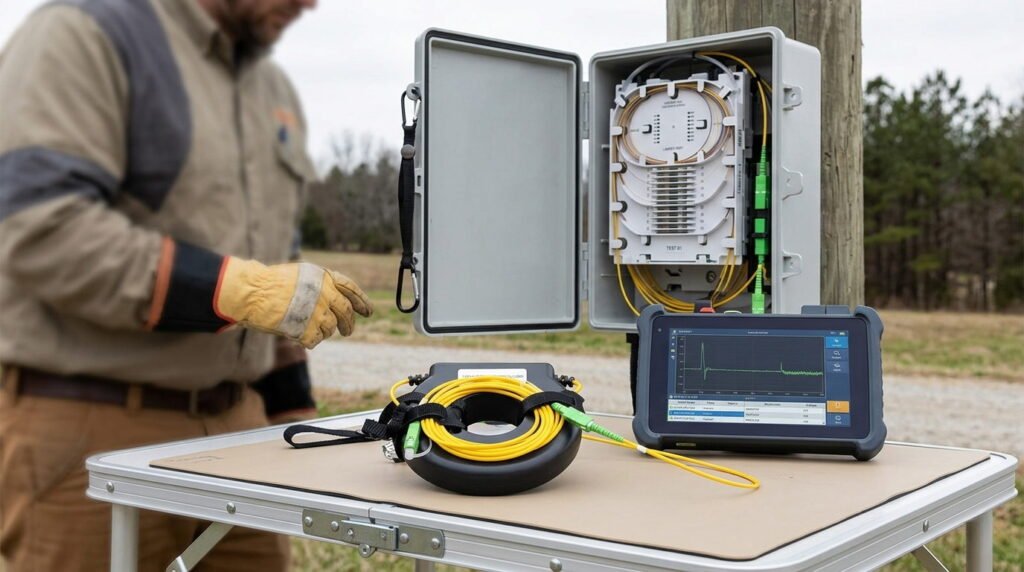
OTDR Launch Cable Ring is the essential tool for every fiber optic technician seeking precision in network certification. When testing high-speed data links, the initial connector pulse often masks critical data near the source. EPCOM provides the industry-standard solution to overcome this “dead zone” challenge. By utilizing a high-quality fiber ring, you ensure that every event from the first connector to the final splice is documented with surgical accuracy. This article explores the technical depth of launch fibers and how they integrate with modern maintenance tools.
Why the OTDR Launch Cable Ring is Mandatory
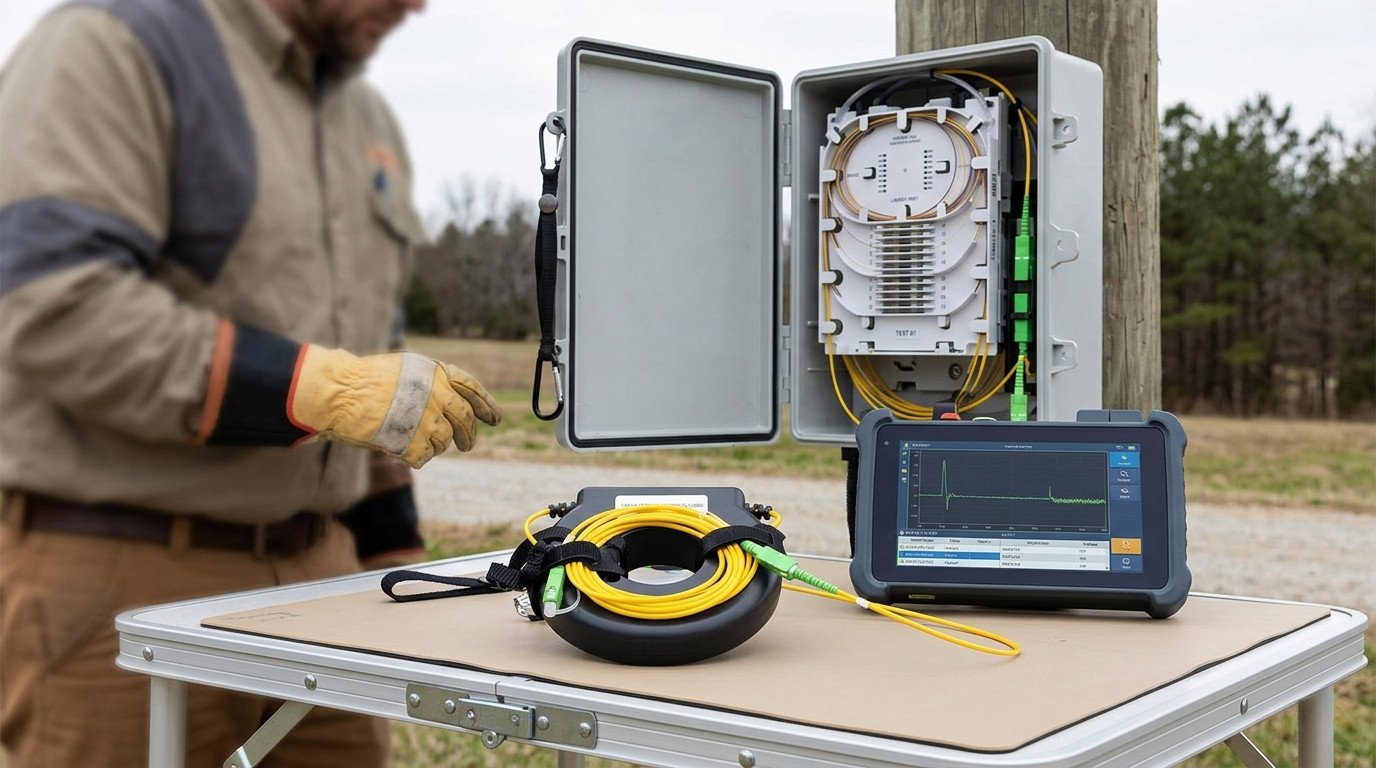
Optical Time Domain Reflectometers (OTDRs) emit high-power light pulses. However, these pulses cause a temporary saturation of the detector. Consequently, the first few hundred meters of the fiber under test remain invisible. This invisible segment is known as the dead zone. An OTDR Launch Cable Ring acts as a bridge. It provides a known length of fiber that allows the OTDR pulse to stabilize before it enters the actual network. Without this stabilization, technicians cannot verify the health of the near-end connector.
Transitioning from basic testing to professional certification requires reliable equipment. EPCOM engineers these rings to be compact and rugged. They are designed for field use in harsh environments. Whether you are working in a data center or a rural telecommunications hub, the portability of the ring ensures consistent results. Furthermore, using a launch fiber protects the OTDR’s expensive optical port from wear and tear. Instead of plugging directly into the network, you plug into the sacrificial connector of the cable ring.
Technical Specs of OTDR Launch Cable Ring Units
The performance of a fiber link depends on the quality of every component. Therefore, the internal fiber of your launch ring must match the fiber under test. EPCOM offers rings in various modes, including G.652D Single Mode and OM3/OM4 Multimode. Consistency in the refractive index is vital. If there is a mismatch, the OTDR might show ghost reflections or inaccurate loss readings. To ensure the highest accuracy, technicians often use a high precision fusion splicer to repair or customize their test leads when necessary.
Moreover, the length of the ring matters. For long-haul networks, a 1000-meter ring is often preferred. For local area networks (LAN), a 150-meter or 500-meter ring is usually sufficient. EPCOM ensures that each OTDR Launch Cable Ring is individually tested for insertion loss and back-reflection. According to standards set by the Telecommunications Industry Association (TIA), maintaining low loss at the launch point is critical for Tier 2 certification.
Comparative Performance Data
| Feature | EPCOM Standard Ring | Generic Fiber Ring |
|---|---|---|
| Typical Insertion Loss | < 0.3 dB | < 0.5 dB |
| Fiber Quality | Corning / OFS Grade | Standard Grade |
| Housing Durability | High-Impact Polymer | Standard Plastic |
Optimizing the OTDR Launch Cable Ring Workflow
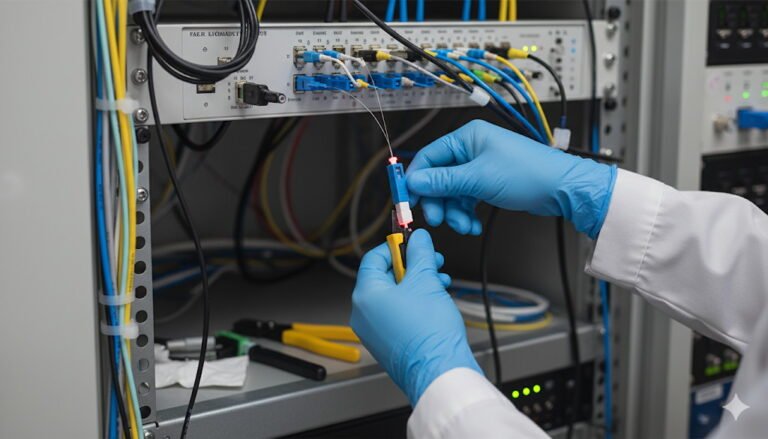
Efficiency in the field leads to higher profitability. To optimize your workflow, start by cleaning every connector. Dirty connectors are the primary cause of fiber failure. Using fiber optic cleaning wipes before connecting the OTDR Launch Cable Ring is non-negotiable. Even a microscopic dust particle can permanently damage the ceramic ferrule or cause massive signal attenuation. EPCOM recommends a “Inspect, Clean, Inspect” protocol for all fiber deployments.
Additionally, visual verification helps in identifying macro-bends or broken fibers near the patch panel. A portable VFL is the perfect companion for your testing kit. While the OTDR gives you a distance map, the VFL allows you to see the actual leak of light. Together with the OTDR Launch Cable Ring, these tools form a comprehensive diagnostic suite. By using multiple methods of verification, EPCOM ensures that your network meets the rigid demands of 5G and IoT infrastructure.
Understanding the Dead Zone Reduction
The primary function of the OTDR Launch Cable Ring is dead zone mitigation. When the OTDR sends a pulse, it creates a reflection at the source. This reflection is so strong that the receiver is temporarily “blinded.” The length of the launch fiber allows the receiver to recover. Consequently, the technician can see the first connection of the actual cable under test. This is why EPCOM focuses on precision-wound fiber spools. If the internal winding is too tight, it can induce micro-bends, which distort the test results.
Graphic 1: Comparison of signal recovery with and without the EPCOM launch solution.
Maintenance and Longevity of the OTDR Launch Cable Ring
A high-quality testing tool is an investment. Therefore, protecting the OTDR Launch Cable Ring is crucial for long-term ROI. EPCOM designs its rings with a robust outer shell. However, the connectors remain the most vulnerable part. Always replace the dust caps immediately after use. If a connector becomes scratched, the entire ring’s accuracy is compromised. Industry leaders like Corning Optical Communications emphasize the importance of clean interfaces in high-speed networks. Using the correct cleaning tools ensures that your OTDR Launch Cable Ring remains calibrated for years.
Furthermore, periodically check the fiber for any physical damage. If the ring is dropped, the internal fiber could snap or develop a high-loss bend. In such cases, the OTDR trace will show a massive loss where there should be none. EPCOM provides repair services and replacement leads to keep your testing operations running smoothly. Reliability is the hallmark of EPCOM equipment. By integrating our solutions into your toolkit, you are choosing quality that lasts.
Advanced Applications for the OTDR Launch Cable Ring
Beyond simple testing, the OTDR Launch Cable Ring is used in laboratory settings. Researchers use these rings to simulate long-distance transmission. Because the fiber is contained in a small ring, it saves space in the lab. EPCOM also offers customized lengths for specific R&D requirements. Whether you need G.657A1 bend-insensitive fiber or standard G.652D, we can provide it. This flexibility makes our ring a favorite among telecommunications universities and private research firms.
In conclusion, the OTDR Launch Cable Ring is more than just a spool of fiber. It is a precision instrument designed to provide clarity where there is normally chaos. By eliminating the dead zone, it allows technicians to provide accurate, professional reports. EPCOM is committed to delivering the best optical solutions to the global market. Our products, from fusion splicers to launch rings, are built to the highest standards of the International Electrotechnical Commission (IEC). Trust EPCOM for your next fiber infrastructure project.
About EPCOM
EPCOM is a leading provider of fiber optic testing and installation equipment. We specialize in high-performance tools that ensure the integrity of optical networks worldwide. Our mission is to simplify fiber testing through innovation and quality engineering. Visit our product catalog to see the full range of OTDR accessories and cleaning solutions.